Sales tax compliance in Canada is one of the most important—and often misunderstood—parts of running a business. In 2026, businesses selling across provinces must navigate a mix of federal GST, harmonized HST, and provincial PST systems. Understanding sales tax compliance Canada provinces 2026 rules is essential to avoid penalties, incorrect filings, and audit risks.
Whether you run an online store or a multi-location retail business, your tax obligations depend heavily on where your customers are located and how your business is registered.
Do You Charge Different Sales Tax Rates in Different Canadian Provinces?
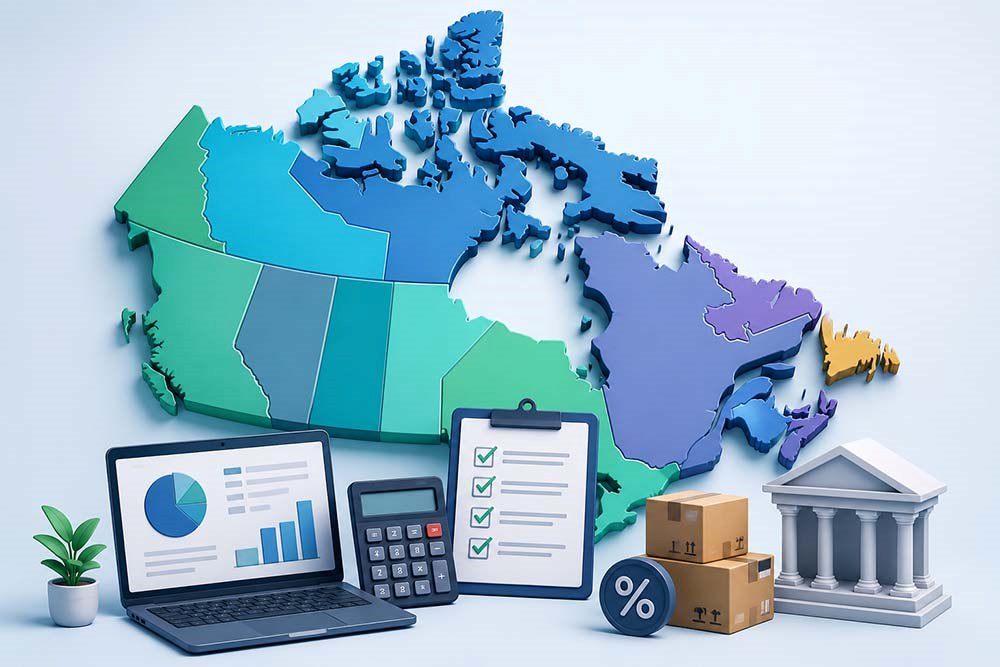
Yes. Canada does not use a single national sales tax rate. Instead, taxation depends on the province where the sale is considered to occur.
The three main systems:
1. GST (Goods and Services Tax)
- Federal tax rate: 5%
- Applies across all provinces
2. HST (Harmonized Sales Tax)
Some provinces combine federal and provincial taxes into one:
- Ontario
- Nova Scotia
- New Brunswick
- Newfoundland and Labrador
- Prince Edward Island
HST rates range from approximately 13% to 15%, depending on the province.
3. PST/QST (Provincial Sales Tax systems)
Some provinces apply separate provincial taxes:
- British Columbia (PST)
- Saskatchewan (PST)
- Manitoba (RST)
- Quebec (QST, administered separately)
- Alberta (no provincial sales tax, only GST)
Key rule: You generally charge tax based on the destination province of the customer, not where your business is located (especially for online sales).
Do Online Businesses Need to Collect Sales Tax Across All Provinces?
In most cases, yes—if you meet registration thresholds or have “nexus” (tax presence) in multiple provinces.
You must collect sales tax in other provinces if:
- You exceed federal or provincial revenue thresholds
- You store inventory in multiple provinces (including third-party warehouses)
- You operate marketplaces or use fulfillment services
- You have employees or physical presence in a province
- You are a non-resident selling into Canada above registration limits
For e-commerce businesses, multi-province sales tax Canada compliance is especially important due to cross-border digital sales.
In 2026, tax authorities are increasingly focused on online sellers and digital services compliance.
What Happens If You Collect the Wrong Sales Tax Rate in Canada?
Collecting the wrong tax rate can create serious financial and legal issues.
Possible consequences:
1. CRA or provincial audits
Tax authorities may review your filings and customer invoices.
2. Penalties and interest
You may be required to:
- Pay unpaid tax amounts
- Pay interest on under-collected taxes
- Pay penalties for incorrect filings
3. Customer disputes
If you overcharge tax:
- Customers may request refunds
- It can damage trust and reputation
4. Refiling requirements
You may need to:
- Amend previous returns
- Reconcile underpaid or overpaid taxes
Key insight: Even small errors in provincial tax rates can compound quickly for high-volume businesses.
How Do You Register for Sales Tax in Multiple Provinces in Canada?
Registration depends on whether you operate federally, provincially, or across multiple jurisdictions.
Step-by-step process:
1. Register for a GST/HST number
- Done through the Canada Revenue Agency (CRA)
- Required for most businesses earning above $30,000 annually (small supplier threshold)
2. Determine provincial obligations
You may also need separate accounts for:
- PST (British Columbia, Saskatchewan, Manitoba)
- QST (Quebec)
3. Register with provincial tax authorities
Examples:
- Revenu Québec for QST
- Provincial finance ministries for PST provinces
4. Set up tax collection systems
- Configure accounting software or POS systems
- Apply correct tax rules based on customer location
- Automate tax calculation where possible
5. Maintain ongoing filings
- File GST/HST returns with CRA
- File PST/QST returns with provincial authorities where applicable
Key Differences Between GST, HST, and PST Explained Simply
GST (Federal)
- Uniform across Canada
- 5% rate
- Collected by CRA
HST (Federal + Provincial combined)
- Single tax rate
- Simplified filing system
- Collected by CRA
PST/QST (Provincial)
- Separate from federal tax
- Different rules per province
- Often requires separate filings
Common Mistakes Businesses Make in Multi-Province Tax Compliance
- Charging a single flat tax rate nationwide
- Ignoring provincial registration requirements
- Misclassifying customer location for tax purposes
- Not updating tax rules in POS or e-commerce systems
- Failing to track digital sales correctly
These mistakes are especially common in growing online businesses.
How to Stay Compliant in 2026
To manage sales tax compliance effectively:
- Use automated tax software (Shopify Tax, Avalara, etc.)
- Regularly review provincial tax updates
- Keep accurate customer location data
- Separate GST/HST and PST/QST filings properly
- Work with an accountant for multi-province operations
Conclusion
Sales tax compliance in Canada is complex because each province applies different rules, rates, and filing systems. In 2026, businesses—especially online sellers—must carefully manage GST, HST, and PST obligations to remain compliant. Understanding how sales tax compliance Canada provinces 2026 rules work is essential for avoiding penalties and maintaining smooth operations across the country.
FAQ’s
Q1. Do I charge different sales tax rates in different Canadian provinces?
A: Yes. Tax rates vary by province depending on whether they use GST, HST, or PST systems, and the correct rate is usually based on the customer’s location.
Q2. What happens if I collect the wrong sales tax rate in Canada?
A: You may face audits, penalties, interest charges, customer refunds, and requirements to amend past tax filings.
Q3. Do online businesses need to collect sales tax across all provinces?
A: Yes, if they meet registration thresholds or have tax presence (nexus) in those provinces. E-commerce businesses are especially affected.
Q4. How do I register for sales tax in multiple provinces in Canada?
A: You register for GST/HST with the CRA and then register separately for PST or QST with provincial tax authorities where required.